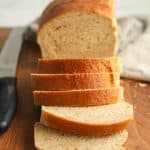
Whole Wheat Sourdough Sandwich Bread
Now that we are all baking with sourdough, let's make some Whole Wheat Sourdough Sandwich Bread, shall we? This bread adds some complex flavors, incorporating whole wheat flour and honey into an amazing, light-tasting bread! Perfect for sandwiches or avocado toast!
Servings 10 slices (one loaf)
Calories 241kcal
Ingredients
- 100 grams active bubbly sourdough starter
- 150 grams warm milk
- 175 grams warm filtered water
- 40 grams olive oil
- 40 grams honey
- 125 grams whole wheat flour - unbleached
- 350 grams bread flour - unbleached
- 35 grams all-purpose flour
- 12 grams fine sea salt
Instructions
- ** It's important to measure the ingredients for this recipe in grams. The kitchen scale I use is linked in the recipe. **
- Measure ingredients. Use a kitchen scale to measure the water, milk, and sourdough starter and add to a large bowl. Stir well with a fork. Add the remaining ingredients in the order listed - olive oil, honey, whole wheat flour, bread flour, all-purpose flour, and sea salt. Stir again.175 grams warm filtered water, 150 grams warm milk, 100 grams active bubbly sourdough starter, 40 grams olive oil, 40 grams honey, 125 grams whole wheat flour, 350 grams bread flour, 35 grams all-purpose flour, 12 grams fine sea salt
- Then use your hands to bring everything together. The dough will look scraggy. Cover with a damp towel, and set a timer for 30 minutes. This is the AUTOLYSE.
- Do stretch and fold. Do a stretch and folding of the dough for about one minute, rotating the bowl as you do the folds. Place the dough seam-side down in the bowl, and cover with the towel again. Adjust if needed: If the dough feels stiff or tight, add a few drops of water until it softens and becomes easy to work with. If it feels overly sticky or slimy, sprinkle in a few extra grams of flour to bring it back to a comfortable, workable texture.
- ADDITIONAL STRETCH AND FOLDS: I recommend doing additional stretch and folds if time permits. Do these every 30 minutes for 3-4 more times to further develop the gluten structure.
- Leave dough set on the counter-top for 6-8 hours, or overnight depending on several factors. The dough should double in size. This is the BULK RISE (or bulk fermentation).To avoid getting a crusty layer on the dough during the bulk rise, make sure the bowl is large and the towel is damp. You can also add a light coating of oil over the top of the dough, especially if you are letting it sit out overnight.
- Form loaf. Dust your counter or a baking mat with a light amount of flour. Move your dough from the bowl to the counter and form into your desired shape. Don't punch down, but pull the outsides inward to form shape. Let the dough sit for five minutes.Then pull the dough towards you and away, trying to get the dough to be as tight as possible.
- Let rise again. Spray a loaf pan with baking spray. Place the dough inside the pan. Cover with a damp towel and let it rise until the bread is just starting to rise above the rim of the pan, about two hours or so. This is the SECOND RISE (or final rise).
- NOTE: After you shape your sourdough loaf, you can place it in the refrigerator for 8–10 hours (or even longer). The cold slows the yeast way down, which lets the dough ferment gently and build deeper flavor without over‑proofing. When you’re ready to bake, take the loaf out, let it finish rising at room temperature until the dough looks slightly puffy again, then bake as usual. It’s an easy way to fit sourdough into your schedule and make it taste even better.
- Bake. When the dough is risen, preheat the oven to 350 degrees for about 38 - 43 minutes, or until a digital thermometer measures between 195-200 degrees F when inserted into the center of the bread.
- Let cool. Remove pan and place bread on a cooling rack. Brush some butter on top of the loaf to create a shiny exterior.
- Slice. Let the bread COMPLETELY COOL before slicing.
Notes
EXPERT TIPS:
- Make sure your starter is ready. If you store your starter in the refrigerator between use, make sure it’s active and ready to go before baking with it. I often feed it 2-3 times before using it after resting (i.e. sleeping in the refrigerator).
- Be flexible. If you’re bulk rise is taking longer than normal, or the starter isn’t as bubbly as you’d like it, be flexible. You can add time to either of these, and still make delicious bread. Many factors will come in to play as to when your sourdough is ready. In the summer months, the humidity and heat will make the process shorter. In the winter months, the process may be longer.
- Measure carefully and then adjust as needed. Make sure you use a digital scale to measure your ingredients in grams. This is important. Even with measuring carefully, you MAY need to adjust slightly. When your hands are on the dough doing stretches and folds, you will come to feel if more water/more flour is needed to make the dough pliable and soft. This comes with practice.
- Practice. Like I said above, as you practice making this bread and enjoying the bounties, you’ll learn all the little nuances to the sourdough process. Practice makes perfect!
- Let the bread cool. One of the biggest mistakes you can make is to slice the bread immediately after coming out of the oven. If you do this, it will be doughy tasting. Let the bread completely cool before slicing!
Nutrition
Calories: 241kcal | Carbohydrates: 42g | Protein: 7g | Fat: 5g | Saturated Fat: 1g | Polyunsaturated Fat: 1g | Monounsaturated Fat: 3g | Cholesterol: 1mg | Sodium: 473mg | Potassium: 108mg | Fiber: 2g | Sugar: 4g | Vitamin A: 31IU | Vitamin C: 1mg | Calcium: 29mg | Iron: 1mg